


Knowledge to go
Find data sheets, product information, and technical downloads for our motor portfolio.
Robotic applications place high demands on torque, weight, precision, and installation space. Whether it is a collaborative robot, humanoid, quadruped walking robot, or mobile unmanned ground vehicle: the drives must enable dynamic movements, be precisely controllable, and integrate compactly into joints and manipulator axes.
TQ-RoboDrive offers torque-strong frameless motor for robotics and custom actuators. Our ILM-E servomotors combine high torque density with low weight, a large hollow shaft, and a high degree of design freedom. Dynamics, controllability, and thermal behavior are designed for the requirements of modern robotic applications.
Which motors are suitable for robotics applications?
For modern robotic applications, frameless servomotors are particularly suitable. Thanks to their frameless design, the stator and rotor can be integrated directly into the robot joint or manipulator axis and combined with gearing, sensors, bearings, and power electronics to form a compact actuator.

For cobots, humanoid robots, quadrupeds, and the manipulator axes of mobile robots, we primarily recommend our ILM-E series. It was designed as a cost-optimized evolution of the ILM series and offers similar product features at an attractive price-performance ratio. This makes it especially suitable for scalable robotics projects and higher production volumes.
Hall and temperature sensors are integrated as standard in the ILM-E series. The compact SMD Hall sensors require very little installation space, which makes integration into compact robot joints easier.
Regardless of the selected series, our motors are available with different winding configurations. Different diameters and overall lengths enable targeted matching to the torque, speed, voltage, and installation space of the respective application.

Robot joints must transmit high forces without making the robot unnecessarily heavy or large. High torque density enables powerful drives in a compact installation space. Especially in humanoid robots and quadrupeds, a good torque-to-weight ratio is crucial, as every additional mass affects the upstream joints, dynamics, and energy consumption.

Cobots, humanoids, and walking robots perform rapid accelerations, direction changes, and precise movements. Motors with low rotor inertia mass respond particularly quickly to control commands and support precise torque, speed, and position control. This makes it possible to reliably implement natural motion sequences, rapid load changes, and dynamic interactions.

Frameless motor are integrated directly into the robot joint or the manipulator axis. Designers can tailor the housing, shaft, bearing arrangement, sensors, gearbox, and thermal connection specifically to the respective application. The large hollow shaft also makes it easier to route cables, data lines, or mechanical components and supports a compact, structure-integrated design.

For collaborative robots, the ILM-E series is usually our first recommendation. It enables lightweight and compact joints, offers a high torque density, and can be integrated into the actuator in a space-saving manner thanks to the integrated Hall and temperature sensing.
In addition to compact integration, Cobots require precise torque control, smooth motion sequences, and controllable behavior during interaction with people. Depending on the actuator concept, backdrivability, gear stiffness, and additional torque or position sensors must also be taken into account.
Depending on the project, we support customers not only in motor selection, but also in the development and production of custom actuators.

Humanoid robots require different motor sizes for the neck, arms, hands, hips, knees, and feet. The lightweight and scalable ILM-E series is therefore particularly well suited as a motor platform for different joint classes within a robot.
In addition to high torque density and dynamic response, low weight, compact dimensions, and energy efficiency are crucial. Any additional mass on the arms or legs increases the load on the upstream joints and can raise the energy demand of the overall system.
Different diameters, overall lengths, and winding configurations enable targeted adaptation to the respective joint function. The hollow shaft also supports the internal routing of cables and data lines. For humanoids, we supply frameless motors and, upon request, can assemble and integrate customer-specific actuators (Actuators & System Integration).

In quadrupeds, high dynamics, low weight, and durability under rapid load changes are the focus. The leg axes must handle high torque peaks, accelerations, changes in direction, and shocks.
In addition to these three core characteristics, low rotor mass inertia, high overload capacity, and suitable thermal coupling are therefore particularly important. The weight of the motor also affects the robot’s energy consumption and mobility, especially in the outer leg segments.
The ILM-E series is our preferred solution due to its ratio of torque, weight, installation space, scalability, and cost. Depending on the joint, different diameters, lengths, and winding configurations can be combined. In addition to individual motor kits, customer-specific assembled and integrated actuators are possible.

Mobile robots and UGVs often combine a mobile platform with a multi-jointed manipulator. They are used, among other things, for inspection, exploration, and handling tasks—especially when the environment is difficult for people to access or hazardous.
For the manipulator axes, we recommend motors from the ILM-E or ILM series depending on the quantity and requirement profile. What matters are high torque density, a good ratio of lifting force to own weight, and precise motion control.
Since mobile robots often operate on battery power, efficient operation is also important. In demanding environmental conditions, robustness, temperature range, mechanical loads, and the protection concept of the complete actuator must also be taken into account.
For scalable platforms and higher quantities, the ILM-E series offers a lightweight and cost-optimized solution. For particularly high requirements in terms of custom design, thermal resilience, or robustness, the ILM series may be the right choice.
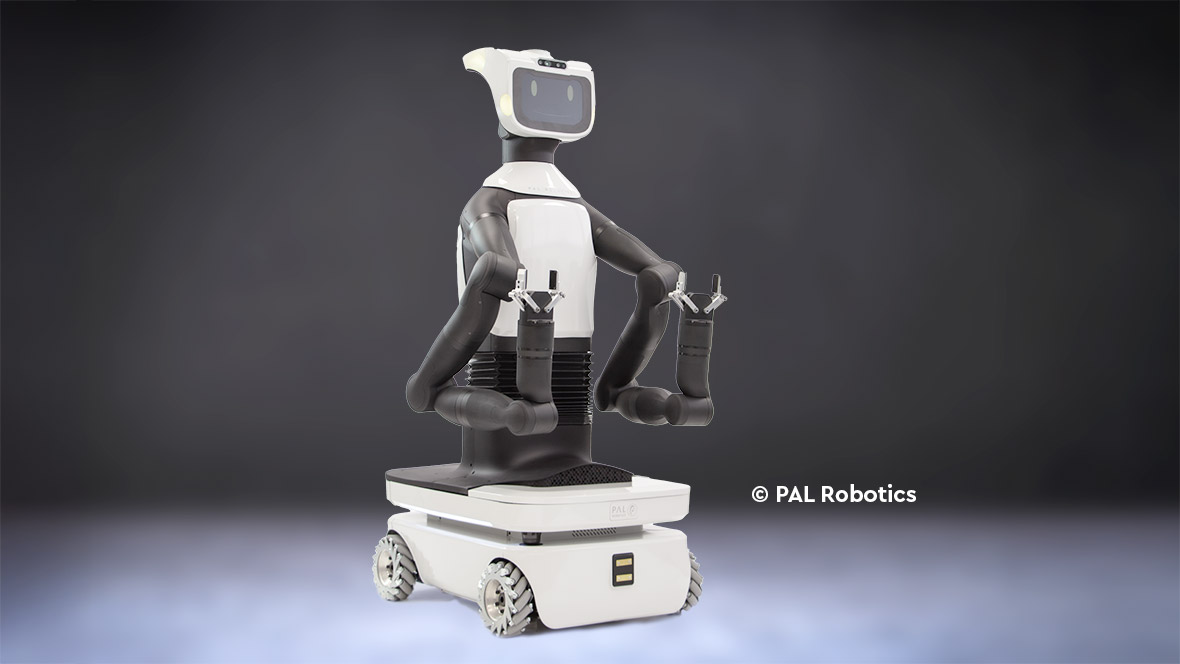
PAL Robotics: motors for humanoid robots and mobile manipulators
PAL Robotics has relied on the drive technology from TQ-RoboDrive since its first robot prototypes. Following the successful start with ILM motors, the company now uses ILM-E motors - among other applications in humanoid robots, mobile manipulators, and service robots. The decisive factors are the high torque-to-weight ratio, the compact integration, and the large hollow shaft, which makes it possible to route cables and lines through the joints in a space-saving way.

Telerob: Servomotors for mobile robots and unmanned ground vehicles
Telerob develops mobile robots and unmanned ground vehicles for demanding operations, such as ordnance disposal, hazard detection, and industrial hazard defense. In the joints of the EOD robots telemax EVO PLUS and telemax EVO PRO, ILM motors from TQ-RoboDrive are used. The key factors are high power density in a compact installation space, precise motion control, a good ratio of lifting force to self-weight, efficiency in mobile operation, and suitability for demanding operating conditions.

RobCo: ILM-E motors for modular robot systems
RobCo develops modular robotic systems for flexible automation tasks in industry and logistics. The standardized modular system enables different robotic arm kinematics and combines hardware, software, and integration into a scalable overall system. For the drive technology, RobCo relies on ILM-E motors from TQ-RoboDrive. The decisive factors are above all the high torque density, the easy integration into the modular concept, and an attractive price-performance ratio.
Frameless motors are particularly well suited for robotics because they combine high torque density, dynamic response, and great design flexibility. Since they have no dedicated motor housing, no built-in bearings, and no separate motor shaft, the stator and rotor can be directly integrated into the robot joint. Designers can precisely tailor the mechanics, gearbox, sensors, cooling, and hollow shaft to the specific application.
Compact frameless servomotors with high torque density and precise controllability are well suited for cobots. Smooth motion sequences, controllable dynamic behavior, and space-saving integration are particularly important, as cobots work in direct proximity to people. TQ-RoboDrive often recommends the ILM-E series, whose Hall and temperature sensors are integrated as standard. Depending on the safety and control concept, additional position or torque sensors may be required.
Lightweight frameless servomotors with high torque density, dynamic response, and a range of sizes are well suited for humanoid robots. Small motors can be used in the neck, hands, and wrists, while shoulder, hip, and knee joints require higher continuous and peak torques. For scalable humanoid platforms, TQ-RoboDrive primarily recommends the ILM-E series. Low weight, energy efficiency, and a hollow shaft for internal cable routing are additional advantages.
Motors for quadrupeds must offer high torque density, dynamic response, and flexible integration. In addition, low weight, low rotor inertia, high overload capacity, and suitable thermal coupling are important. The leg axes are exposed to rapid accelerations, impacts, and high torque peaks. For scalable quadruped platforms, TQ-RoboDrive recommends the ILM-E series as the preferred choice.
For manipulator axes of mobile robots and UGVs, compact frameless servo motors with high torque density, precise controllability, and efficient operation are well suited. They support a good ratio of lifting force to dead weight and help use the available battery energy efficiently. The ILM-E series is often suitable for scalable platforms. For particularly high requirements regarding custom design, thermal load capacity, or robustness, the ILM series may be an option.
The appropriate motor size is determined based on the complete load, motion, and temperature profile. Relevant factors include continuous and peak torque, speed, duty cycle, accelerations, gear ratio, and supply voltage. In addition, installation space, motor weight, hollow shaft diameter, overload capability, sensor technology, and thermal connection must be taken into account. TQ-RoboDrive offers ILM and ILM-E motors with different diameters, overall lengths, and winding configurations.

